
Imagine typing “best wireless headphones” into ChatGPT or Perplexity, and your favorite brand never shows up, or worse, it appears as three slightly different names with zero citations. In 2026, this isn’t bad luck. It’s what happens when brands ignore Brand Name Normalization Rules. AI search engines don’t guess keywords anymore. They reconcile real-world entities. If your name, spelling, capitalization, or domain signals are scattered across the web, AI treats you as multiple weak brands instead of one strong one. This quick guide breaks down exactly what brand name normalization rules are, why they’re now a make-or-break factor for visibility, and the practical steps that actually move the needle in Google AI Overviews, Perplexity, and ChatGPT Search.
What are Brand Name Normalization Rules
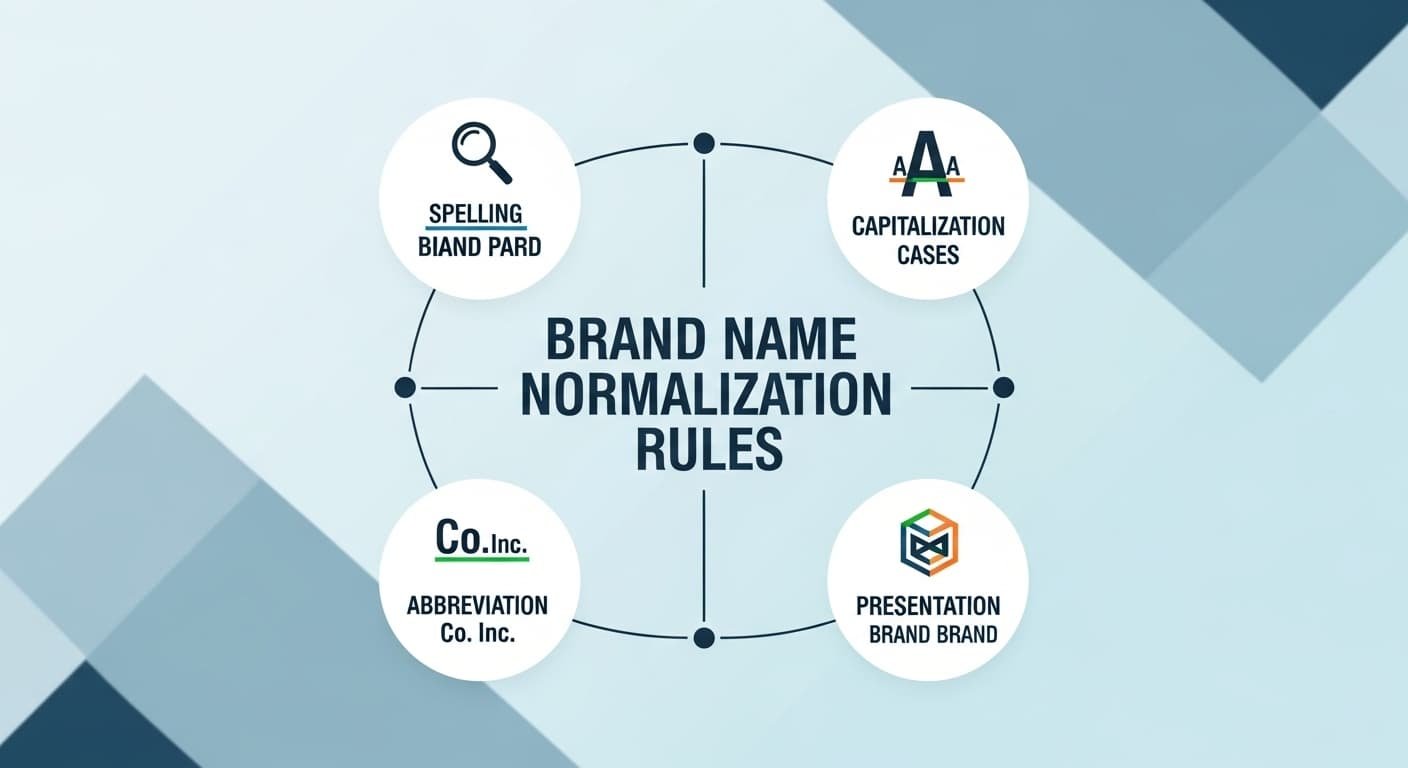
Brand name normalization rules are the simple but strict guidelines that keep your brand spelled, capitalized, abbreviated, and presented the same way everywhere online. Think of them as the “single source of truth” for your identity.
Instead of letting “Acme Solutions,” “acme solutions,” “Acme Co.,” or “acmesolutions.com” float around, you lock in one official version — exact spelling, exact capitalization, exact domain. AI systems then confidently link every mention, review, press release, and schema markup back to the same entity in their knowledge graph. Without these rules, your brand fragments into dozens of weaker signals. With them, you become one clear, authoritative entity that AI loves to cite.
AI search doesn’t “guess”—it reconciles entities.
Traditional Google matched keywords. Today’s AI search (Google AI Overviews, Perplexity, ChatGPT Search) builds knowledge graphs. It scans millions of pages, social profiles, directories, and news stories to decide: “Is this the same brand or three different ones?”
A 2026 SparkToro study revealed the harsh reality: there’s less than a 1% chance ChatGPT or Google’s AI will return the same brand list twice when asked the same question 100 times. Inconsistent naming makes AI unsure which entity to trust, so it either skips you or splits credit across fragments. Normalization rules remove that doubt. They give AI the clean, repeated signals it needs to say, “Yes — this is definitely Acme Solutions.”
The impact of brand consistency on search engine rankings
Consistency directly boosts both traditional rankings and AI citations. Brands with uniform naming across their site, LinkedIn, directories, and backlinks see stronger entity authority. Recent data shows that consistent cross-platform entity signals can deliver up to 10x more AI Overview features than competitors with messy naming.
Inconsistent brands suffer “signal dilution.” AI confidence drops, citations vanish, and even classic SEO rankings soften because Google now weighs entity clarity heavily. One mismatched domain or random abbreviation can quietly cost you visibility in both human searches and zero-click AI answers.
Subscribe to our bi-weekly newsletter.
Want the latest AI SEO tactics, real case studies, and ready-to-use templates delivered straight to your inbox? Subscribe to our bi-weekly newsletter — it’s free and packed with actionable insights that help brands stay visible as AI search evolves.
Why AI search optimization changes the game
AI search optimization (often called GEO or Generative Engine Optimization) flips the old rules. Users now get direct answers instead of blue links. Zero-click searches are the norm, and visibility is measured by citations and mentions inside AI responses — not just clicks.
By 2026, AI platforms will handle 12–15% of global search share, with Google AI Overviews reaching billions of users. Brands that appear in those synthesized answers gain massive implied endorsement. Normalization rules are the foundation: without a single, clear entity, AI simply cannot trust or cite you reliably.
Common brand name normalization mistakes
Most brands make these errors without realizing it:
- Capitalization flips (“Acme Solutions” on the homepage but “acme solutions” in press releases)
- Abbreviation chaos (“Acme Co.” vs “Acme Corp” vs “Acme”)
- Multiple domains or social handles pointing to the same brand
- Outdated bios or founding dates across directories
- Inconsistent product names in reviews and third-party sites
- Missing or conflicting schema markup
Each variation tells AI “this might be a different company,” fracturing your entity and lowering citation rates.
Brand name normalization techniques that actually work
Start with one canonical name and enforce it everywhere. Then:
- Deploy consistent Organization schema markup with the exact name, logo, and SameAs links to Wikipedia, LinkedIn, Crunchbase, etc.
- Run a full audit (Google Sheets template works great), mapping every variation across 20+ platforms.
- Secure exact-name backlinks and mentions from high-authority sites.
- Update all directory listings, social profiles, and press bios to match the canonical version.
- Monitor weekly with simple prompts in Perplexity or custom GPTs to catch new inconsistencies.
These steps are low-cost and deliver measurable lifts in entity confidence within weeks.
What strategies improve brand visibility in AI search engines?
Focus on three proven levers:
- Entity reinforcement: Every new piece of content (blog, video, podcast) must use your exact normalized name and include structured data.
- Third-party validation: Earn mentions from trusted sources — reviews, industry roundups, Reddit threads — using the canonical name.
- Continuous monitoring: Track citation frequency across ChatGPT, Perplexity, and Google AI Overviews. Brands that test and refine weekly see 150%+ higher citation rates.
Combine these with strong E-E-A-T signals (Experience, Expertise, Authoritativeness, Trustworthiness), and AI will treat your brand as a go-to source.
SEO brand naming in 2026 is a technical discipline
Gone are the days when naming was purely a creative or marketing decision. In 2026, SEO brand naming sits at the intersection of marketing, PR, development, and data teams. Developers add schema, PR writers lock in exact phrasing, and marketers audit every new campaign. Treat it like a technical SEO project: document the rules, assign ownership, and review quarterly. Brands that do this outperform those still treating naming as “just branding.”
Every piece of content can serve as a signal for an entity.
Your blog post, YouTube video, LinkedIn update, or guest article isn’t just content — it’s another vote for your entity. When every asset uses the exact same normalized brand name and links back to your authoritative page with proper schema, AI sees a unified, trustworthy picture. Inconsistent content creates noise; consistent content builds a rock-solid knowledge graph entry that AI cites confidently.
Future of Brand Name Normalization Rules
Looking ahead to late 2026 and beyond, agentic AI (autonomous agents that shop, book, and decide) will rely even more heavily on clean entity data. Voice assistants, multimodal search, and real-time AI shopping will scan normalized signals instantly. Brands that normalize now will be ready when AI agents start acting on your name without human oversight. The winners will treat normalization as ongoing infrastructure, not a one-time fix.
FAQs
What is the brand normalization definition?
Brand normalization is the process of standardizing your brand’s spelling, capitalization, abbreviations, domains, and online references so AI systems recognize everything as one single entity.
What are the key brand name normalization rules?
Lock in one official name format, use identical Organization schema everywhere, enforce SameAs links, audit and correct variations across all platforms, and ensure every new piece of content (PR, social, blogs) matches the canonical version exactly.
Why do they matter in AI search?
AI doesn’t guess — it reconciles entities. Inconsistent naming fragments your brand, lowers confidence scores, and dramatically reduces citations in ChatGPT, Perplexity, and Google AI Overviews.
How can brands improve visibility in AI search?
Apply strict normalization rules, add structured data, earn consistent third-party mentions, monitor citations weekly, and create every new asset as a clean signal for your entity.
How do brand-name normalization rules affect SEO?
They strengthen entity authority, which now influences both traditional rankings and AI-generated answers. Consistent brands earn higher trust signals, more backlink value, and far better placement in zero-click AI results.
Conclusion
Brand name normalization rules are no longer optional — they’re the foundation of visibility in the AI-first search world of 2026. By choosing one clear name, enforcing it everywhere, and treating every piece of content as an entity signal, you turn AI from a threat into your biggest amplifier.
Start today: audit your current variations, implement schema, and lock in your canonical name. The brands that act now will dominate citations, build unbreakable authority, and stay ahead as AI agents take over discovery.
Ready to future-proof your brand? Drop your biggest normalization challenge in the comments or subscribe to our bi-weekly newsletter for the next deep-dive template. Your future AI visibility starts with one consistent name.

Abdulrahman
Tech writer at whatsontech.net
who loves to write about Ai tools, Apps and Tech guides.