
In 2026, the VC landscape will never be tougher for early-stage SaaS and tech startups. Seed rounds are still happening (median around $4-6 million), but non-AI companies face flat funding, higher revenue thresholds for Series A (now $1.5-2M ARR), and founder dilution that often leaves teams with just 56% ownership post-seed and 36% post-Series A, according to Carta’s latest data.
That’s why thousands of smart founders are turning to the Startup Booted Fundraising Strategy, a revenue-first approach that lets you build, grow, and scale with minimal (or zero) equity give-up. It’s not old-school bootstrapping; it’s a disciplined, customer-funded model that prioritizes profitability, control, and sustainable growth. If you’re tired of chasing valuations at the cost of your ownership and sanity, this guide breaks down exactly how it works, why it’s exploding in popularity right now, and the exact steps to make it work for your startup.
What Is a Startup Booted Fundraising Strategy?
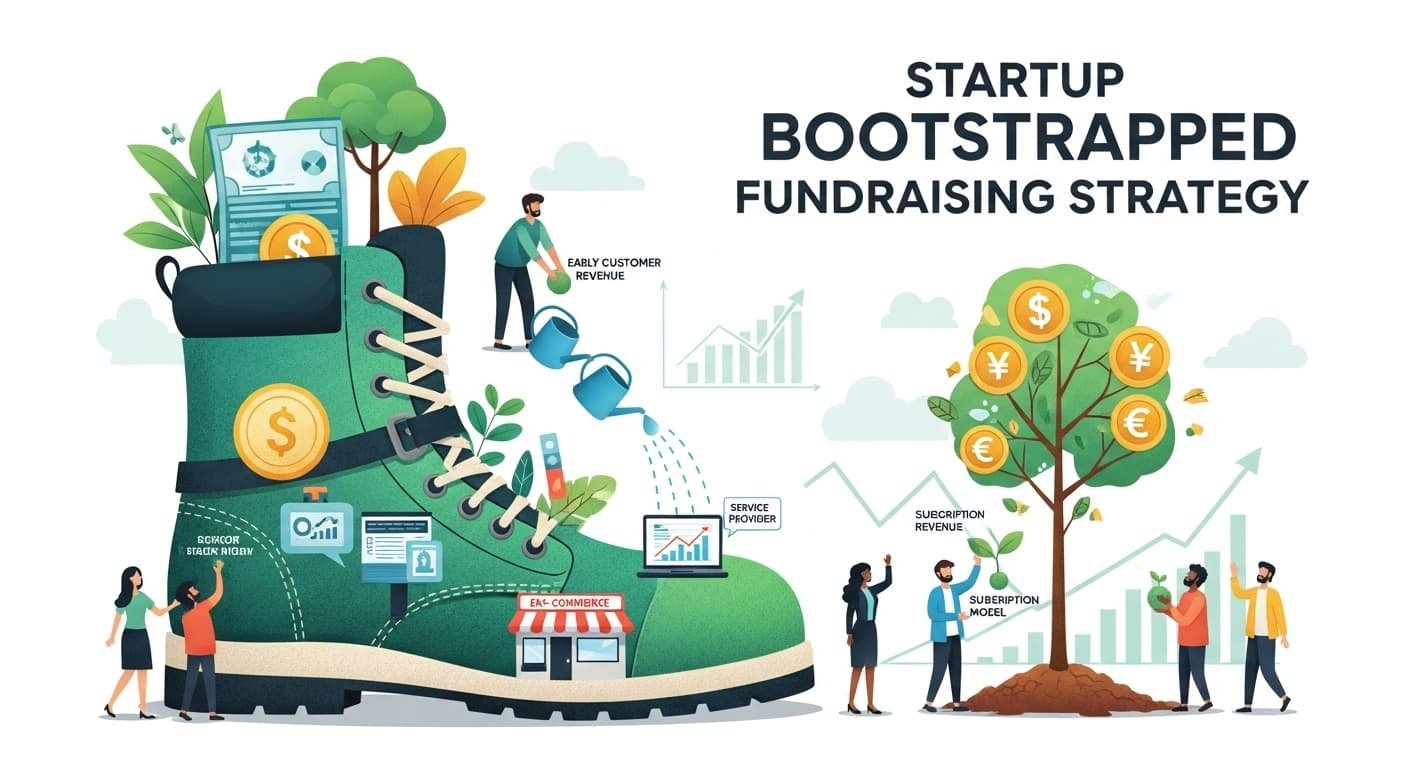
A Startup Booted Fundraising Strategy is a hybrid funding model where founders use early customer revenue to fuel growth instead of raising large equity rounds upfront. You validate demand, launch a revenue-generating MVP, and reinvest every dollar of MRR back into the business.
External capital (if any) comes later and only on your terms through non-dilutive options like revenue-based financing. The goal? Build a profitable company while keeping 80-100% founder control. It’s perfect for SaaS and tech because recurring revenue creates a predictable cash flow you can bank on from day one.
How It Differs From Traditional Startup Funding
Traditional VC funding is all about speed and scale: raise big checks early, burn cash to acquire users, and chase hockey-stick growth for the next round. You trade 15-25% equity per round (often more), accept board seats, and face pressure to hit aggressive milestones or risk down rounds.
Booted fundraising flips the script. Growth is funded by real customers, not investor money. There’s no board oversight dictating pivots, and your runway comes from MRR, not a bank account that’s constantly leaking. The result? You move more slowly at first, but build a far more resilient business.
In the 2025 SaaS Capital benchmarks, bootstrapped companies spent just 95% of ARR (85% were breakeven or profitable), while equity-backed peers burned 107% of ARR, with only 46% reaching profitability.
Why Booted Fundraising Is Gaining Momentum
The numbers tell the story. VC funding for non-AI SaaS stayed relatively flat in 2025 while deal counts dropped. Founders watched valuations reset and dilution climb. Carta reports median founder ownership at Series C is now just 16%. Meanwhile, bootstrapped SaaS median growth hit 20-23% for companies between $3M-$20M ARR, with net revenue retention (NRR) at a healthy 104%.
Revenue-based financing (RBF) is surging because it gives capital without equity loss. Founders are realizing they don’t need $5M+ to prove product-market fit anymore; customers will happily fund it. In a tighter 2026 market, bootstrapped strategies are the smartest path for most SaaS founders who want to stay independent.
The Strategic Shift: Revenue Before Valuation
Forget the old “raise first, build later” playbook. Today’s smartest founders validate with pre-sales, landing pages, and paid pilots before writing a single line of code. Revenue becomes your proof of concept.
This shift happened because investors now demand $1.5M+ ARR before writing a Series A check. By putting revenue first, you de-risk everything: you know the market exists, you have real data to negotiate better terms later, and you avoid the 18-20% dilution that used to be standard.
When Is This Strategy the Right Fit?
This approach shines for B2B SaaS and tech products with predictable recurring revenue, relatively short sales cycles, and strong unit economics from day one. Think tools that solve painful, frequent problems for small-to-medium businesses, project management, analytics, automation, where customers are willing to pay monthly right away.
When a Startup Booted Fundraising Strategy Makes Sense
It makes perfect sense if you’re pre-revenue or under $500K ARR, have a clear path to $10K-$50K MRR within 12 months, and value control over hyper-growth. It’s also ideal if you’re in a niche that doesn’t need massive upfront marketing spend or if you’re an experienced founder who’s done the VC rodeo before and wants something different this time.
Why More SaaS and Tech Founders Are Choosing This Approach
Founders are exhausted by the VC hamster wheel. With 2025 data showing equity-backed companies growing only slightly faster (25% vs. 23%) but losing massive ownership and profitability, the math no longer adds up for most.
Booted founders keep decision-making power, sleep better at night, and build companies they actually own. Plus, AI tools in 2026 make lean operations ridiculously efficient, automating support, content, and even product iteration, so you can compete without a huge team or budget.
How Startup Booted Fundraising Strategy Works in Practice
Start with demand validation (landing page + waitlist + pre-sales). Launch a minimal viable product that generates real MRR within weeks. Reinvest 60-80% of revenue into growth while keeping the rest for runway and profit.
Hire only when revenue justifies it (freelancers first). Track every dollar with simple dashboards. When you hit meaningful scale ($1M+ ARR), you can selectively add RBF or venture debt from a position of strength, no desperate pitch decks required.
Fundamental Advantages of a Startup Booted Fundraising Strategy
Here’s a clear comparison:
| Aspect | Booted Fundraising Strategy | Traditional VC Funding |
| Founder Ownership | 80-100% retained | Often drops to 36% by Series A, 16% by C |
| Profitability Timeline | Break-even or profitable within 12-24 months | 55% still losing money even at scale |
| Decision Control | Full founder control | Board seats and investor pressure |
| Risk Level | Lower personal financial risk | High burn rate, runway pressure |
| Growth Speed | Steady 20-23% median | Faster but volatile |
| Exit Flexibility | Sell on your timeline | Investor-driven 5-10 year exits |
Challenges Founders Face With Booted Fundraising
Cash flow can feel tight in the early days. Scaling without a big marketing budget means slower initial growth. You might face competitive pressure from heavily funded rivals. And yes, the psychological grind of doing more with less is real, especially when your VC-funded friends post big funding announcements.
Step-by-Step Startup Booted Fundraising Strategy for SaaS and Tech Startups
- Validate demand with a simple landing page and paid ads (under $1K).
- Build and launch a revenue-generating MVP in 4-8 weeks.
- Price it right and focus on 5-10 paying pilot customers.
- Reinvest MRR aggressively into product and low-cost acquisition (SEO, content, referrals).
- Track metrics weekly and stay lean (no office, no unnecessary hires).
- Hit $50K-$100K MRR, then explore RBF if you want to accelerate.
- Scale profitably or raise strategically from strength.
Best Funding Alternatives for Bootstrapped Startups
When you eventually want capital without full dilution, consider these options:
| Funding Type | Amount Range | Dilution | Best For | 2026 Reality |
| Revenue-Based Financing | $50K-$500K+ | None | Post-revenue SaaS | Fast approval, repay 1.3-2x over 3-5 yrs |
| Venture Debt | $100K-$1M | Minimal | Scaling with revenue | Complements RBF, some warrants |
| Angel / Friends & Family | $25K-$250K | Low | Very early validation | Still viable but smaller checks |
| Traditional VC | $1M+ | 15-25% | Hyper-growth markets | Higher bar needs $1.5M+ ARR proof |
| Government Grants | $50K-$250K | None | Specific industries/tech | Increasing in 2026 for AI & deep tech |
Important Metrics Investors and Founders Should Track
Focus on these five in 2026:
- MRR/ARR: Your lifeblood.
- LTV: CAC: Aim for 3:1 minimum (bootstrapped winners often hit 4-5:1).
- Net Revenue Retention (NRR): 104% median for healthy bootstrapped SaaS.
- CAC Payback Period: Under 12 months is gold.
- Rule of 40: Growth rate + profit margin should equal 40% or more. Revenue per employee is another big one, median now around $130K for private SaaS.
Real Case Studies for Startup Booted Fundraising
TitleCapture started with just $8K and bootstrapped to $4M ARR serving title insurance companies, proof that niche focus wins big. Two brothers behind Buildpad went from $0 to $7,300 MRR in seven months with an AI SaaS side project turned full business. SproutLoud reached $30M revenue entirely bootstrapped from Florida by staying laser-focused on customer-funded marketing tech.
Examples of Booted Fundraising Success
Classic winners like Basecamp and Mailchimp still prove the model works at scale. In 2025-2026, newer stories like the AI bootstrapped tools hitting $1M+ ARR with tiny teams show the playbook is even stronger thanks to modern AI efficiency.
Bootstrapping vs Venture Capital: Which Is Right for Your Startup?
Bootstrapping (or bootstrapping) wins if you want freedom and ownership. VC is right only if you’re in a winner-take-most market that truly needs massive capital to win (think AI infrastructure). Most SaaS founders are better off bootstrapped, 23% growth with full control beats 25% growth while owning a tiny slice.
Financial Discipline: The Real Competitive Edge
Booted founders become masters of efficiency. Every dollar spent must generate revenue. This discipline creates better products, happier customers, and stronger margins. In 2025 data, bootstrapped companies were far more likely to be profitable because they never had the luxury of wasteful spending.
Marketing Without Massive Budgets
Focus on SEO, content marketing, product-led growth, and referrals. In 2026, AI makes this easier than ever, automated content, personalized outreach, and smart lead scoring on a shoestring budget. Many bootstrapped founders hit $100K MRR with zero paid ads by simply solving real problems and letting customers spread the word.
Psychological Reality of Booted Founding
It’s lonely and slower sometimes. You’ll question yourself when VC friends raise big rounds. But the freedom, no board meetings, no investor updates, no pressure to fake growth, is addictive. Most booted founders say the peace of mind is worth more than any valuation.
Bootstrapping in Startup Finance: Context and Strategy
Bootstrapping has always been around, but in 2026, it’s evolved into a sophisticated strategy. It’s no longer “poor man’s funding”, it’s the smart path in a market that rewards proof over promises.
Common Mistakes to Avoid in a Startup Booted Fundraising
Don’t delay revenue to perfect the product. Don’t ignore cash flow. Don’t hire too early. And don’t compare your Chapter 1 to someone else’s Chapter 20 on social media.
Risks and Limitations
Growth can feel slower. You might miss out on network effects in hyper-competitive spaces. Cash flow crunches happen if churn spikes. But these risks are usually smaller than the dilution and pressure of traditional funding.
Future Trends in Startup Booted Fundraising Strategy for Tech Companies
In 2026 and beyond, AI will supercharge bootstrapped strategies, letting solo founders or tiny teams build what used to require dozens of people. Revenue-based financing will keep growing, and we’ll see more “de-bootstrapping” where profitable companies raise strategically later. Expect vertical SaaS and AI-agent tools to dominate the bootstrapped success stories.
FAQs
How much capital does a SaaS startup actually need to get started?
Most bootstrapped SaaS founders launch with under $10K-$50K using no-code tools, personal savings, and early customer payments. You don’t need millions, just enough to validate and ship.
What makes a startup’s bootstrapped fundraising strategy different from traditional fundraising?
Zero or minimal equity dilution, revenue fund growth, and you stay in full control instead of trading ownership for capital.
Can a startup grow fast without venture capital?
Yes. Bootstrapped SaaS companies grew at a median of 20-23% in 2025, and top performers hit 50%+ while staying profitable.
How do I know if my startup is ready for the bootstrapped fundraising approach?
If you can reach $10K-$50K MRR in 6-12 months with your current resources and have strong unit economics, you’re ready.
Can a bootstrapped startup compete with venture-backed competitors?
Absolutely, especially in niches where customers value reliability and service over flashy features. Many bootstrapped companies win by being more focused and profitable.
Conclusion
The Startup Booted Fundraising Strategy isn’t just a funding choice; it’s a mindset that puts you back in the driver’s seat. In 2026’s selective market, the founders who win are the ones who build real businesses that customers are excited to pay for, not just pitch decks that investors fund. Start small, stay disciplined, track your metrics, and watch your company grow on your terms.
If you’re a SaaS or tech founder building the bootstrapped way, drop your biggest challenge or current MRR in the comments. I read everyone. And if this guide helped, share it with a founder who needs to hear it. Here’s to owning your equity and your future.

Abdulrahman
Tech writer at whatsontech.net
who loves to write about Ai tools, Apps and Tech guides.