
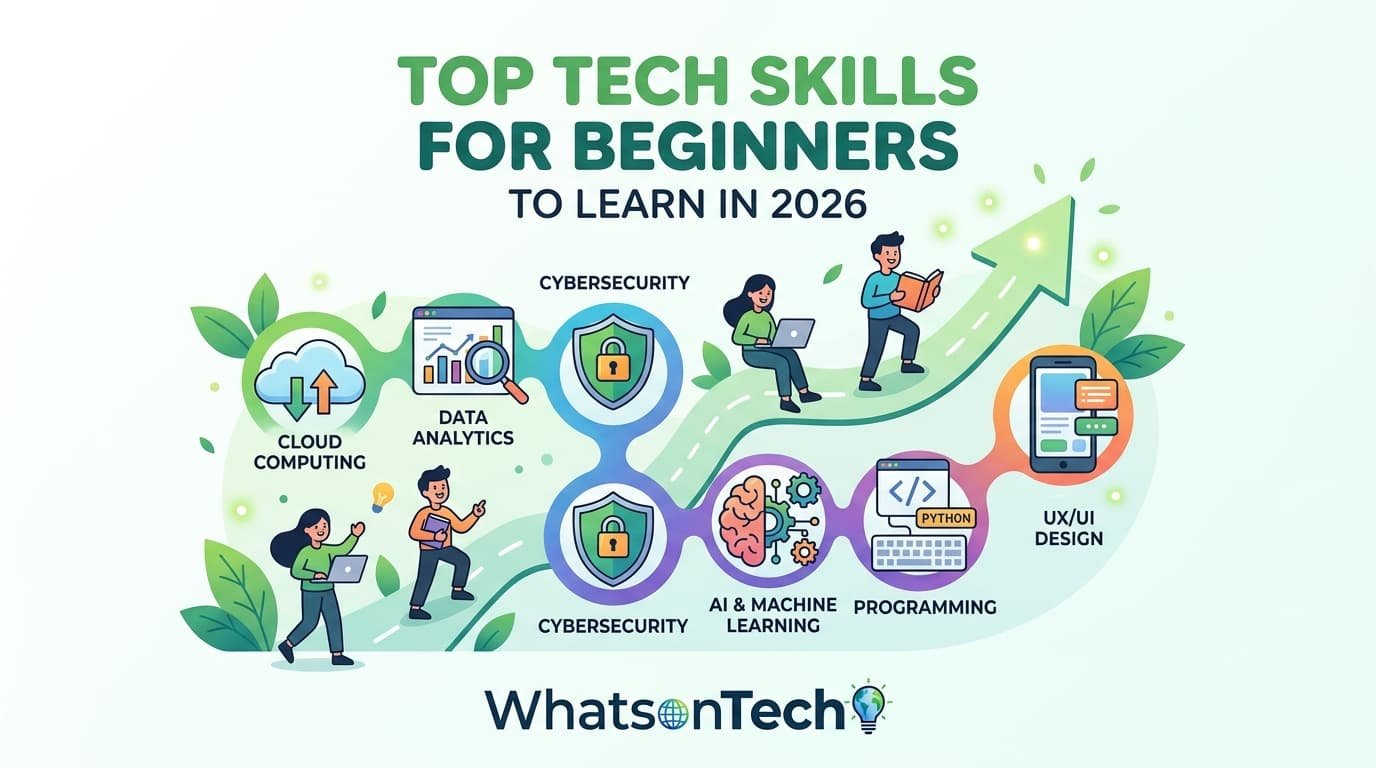
If you’ve been thinking about learning a tech skill but don’t know where to start, 2026 is honestly the best time to begin. The job market is changing fast, and companies across every industry, healthcare, finance, retail, and education, are actively hiring people with digital skills. The good news? You don’t need a computer science degree to get started.
According to Robert Half’s 2026 Salary Guide, 87% of technology leaders feel confident about business growth, and 61% plan to increase their headcount in the first half of 2026. That means real jobs, real demand, and real opportunity, especially for beginners who are willing to learn.
In this guide, we break down the top tech skills to learn in 2026, what they actually involve, how long they take to learn, and what kind of salary you can expect. Whether you’re a student, a career switcher, or someone who just wants to stay relevant, this article is for you.
Why Learning Tech Skills in 2026 Is a Smart Move
The digital economy isn’t slowing down. In fact, according to industry data, nearly half of all workers’ core skills are expected to shift by 2027. That’s not a distant future, it’s happening right now.
Here’s what makes 2026 a turning point:
- AI tools are being built into almost every software product
- Companies are moving systems to the cloud at a record pace
- Cybersecurity threats are rising, creating massive talent demand
- No-code and low-code tools are making tech more accessible than ever
- The median tech salary in the US is around $112,667, more than double the national average
Starting now gives you time to build real, practical skills before the market gets even more competitive.
How We Selected These Skills
Every skill on this list was chosen based on three things:
- Real job market demand – backed by 2026 hiring data from Robert Half, Indeed, Pluralsight, and CompTIA
- Beginner accessibility – skills you can start learning without prior experience
- Salary potential and career growth – because your time is valuable and should lead somewhere
Top Tech Skills to Learn in 2026 for Beginners
1. Artificial Intelligence (AI) Basics
AI is no longer optional; it’s everywhere. AI skill requirements in job postings nearly doubled from 5% in 2024 to over 9% in 2025, and that growth has continued into 2026. Even non-technical roles now expect some baseline understanding of AI tools.
As a beginner, you don’t need to build AI models from scratch. Start with:
- Understanding what AI is and how it works
- Using AI tools like ChatGPT, Claude, and the Gemini productively
- Learning how AI is applied in business, healthcare, and marketing
Average salary for AI/ML roles: $134,000-$193,000 (Robert Half 2026). Time to learn basics: 1-3 months
2. Python Programming
Python is consistently ranked the most beginner-friendly programming language in the world, and in 2026, it’s still the top choice for anyone entering tech. Its clean, readable syntax means you can start writing functional code within days, not months.
Python is the language behind data science, machine learning, automation, and web development. Learning it opens doors to multiple career paths.
What to learn as a beginner:
- Variables, loops, and functions
- Working with libraries like Pandas and NumPy
- Building simple automation scripts
Best free resource: freeCodeCamp, Python.org documentation. Average salary: $109,000-$175,000 for software engineers using Python
3. Prompt Engineering
This is one of the newest and fastest-growing skills in tech, and one of the most accessible. Prompt engineering is the art of writing clear, effective instructions for AI tools to get the best possible outputs.
As generative AI becomes part of everyday business workflows, companies need people who know how to use these tools effectively. The barrier to entry is low: no coding required, and you can learn the basics in 2-4 months.
Why it matters in 2026: 78% of ICT roles now include AI technical skills as a requirement.
4. Cloud Computing
Cloud computing is the backbone of modern business. Companies store their data, run their apps, and manage their systems on cloud platforms, and they need skilled professionals to help them do it.
The three major platforms you’ll hear about are:
| Platform | Parent Company | Best For |
| AWS | Amazon | Widest range of services, most in demand |
| Microsoft Azure | Microsoft | Enterprise and Microsoft ecosystems |
| Google Cloud | Data and machine learning projects |
Executives ranked cloud computing the most important area of business growth for 2026, according to Pluralsight’s Tech Skills report. Cloud engineers earn over $168,000 annually in the US.
Start with the AWS Cloud Practitioner certification, it’s beginner-friendly and globally recognized.
5. Cybersecurity Fundamentals
There are currently 3.4 million unfilled cybersecurity jobs globally, and that gap is only growing. Every organization that stores data, which is basically every organization, needs people who can protect it.
As a beginner, you don’t need to start as a security engineer. Entry-level paths include:
- IT helpdesk with security focus – $50,000–$65,000/year starting salary
- Security analyst – once you’ve built foundational skills
- Cloud security specialist – a growing niche that pays a premium
First certification to get: CompTIA Security+, widely recognized, beginner-level, and a strong resume booster.
6. Data Analytics
Data is the new oil, and companies need people who can make sense of it. Data analytics involves collecting, cleaning, and interpreting data to help businesses make decisions.
You don’t need to be a data scientist to break into this field. As a beginner, focus on:
- Excel – still the most widely used tool in business
- SQL – used to query databases; one of the most in-demand tech skills in 2026
- Tableau or Power BI – data visualization tools that turn numbers into charts
Market stats: Data science and analytics roles saw 62% year-over-year growth in 2026. Basic analysts earn around $82,640 annually; analytics engineers command $129,000+.
7. SQL and Database Basics
SQL (Structured Query Language) is one of those skills that sounds technical but is genuinely learnable in a few weeks. It’s used to communicate with databases, asking questions like “show me all customers who bought something last month.”
Almost every tech role touches data at some point, which means SQL is valuable even if you’re not planning to be a data analyst. It frequently shows up as a required skill in job postings for marketing, operations, finance, and product roles.
Time to learn: 4-6 weeks to get comfortable with the basics. Best free resource: SQLZoo, Mode Analytics, W3Schools SQL
8. Web Development Basics (HTML, CSS, JavaScript)
Building websites might seem old-school, but web development remains one of the most employable tech skills in 2026. If you want to build things, apps, websites, or portfolios, this is where you start.
The beginner path looks like this:
- HTML – the structure of a web page (1–2 weeks)
- CSS – how it looks (2–3 weeks)
- JavaScript – how it behaves (2–3 months)
From there, you can branch into front-end frameworks like React, back-end with Node.js, or full-stack development.
9. No-Code and Low-Code Development
Not interested in writing code but still want to build tech products? No-code and low-code platforms let you create apps, automate workflows, and build websites without traditional programming.
Popular tools in 2026 include:
- Bubble – build full web apps without code
- Webflow – design and publish responsive websites visually
- Zapier / Make – automate repetitive tasks between apps
- Airtable – build databases and workflow tools
These skills are especially valuable for small business owners, marketers, and people who want to automate their work life.
10. UI/UX Design
Every app, website, and digital product needs to be designed. UI (User Interface) design is about how things look; UX (User Experience) is about how they work. Good design can make the difference between a product people love and one they abandon.
Tools like Figma have made it easy for beginners to start designing professionally, and many UX designers never write a single line of code.
What beginners should learn:
- Design thinking and user research basics
- Wireframing and prototyping in Figma
- Accessibility and responsive design principles
Google’s UX Design Certificate on Coursera is one of the most recommended beginner paths. It takes about 6 months and costs very little.
11. DevOps Basics
DevOps sits at the intersection of software development and IT operations. In simple terms, it’s about building software faster, more reliably, and with fewer bugs. DevOps engineers earn between $118,000 and $173,750 annually, according to Robert Half’s 2026 data.
For beginners, start with these foundational tools:
- Git – version control; essential for any tech role
- Linux command line – understanding how servers work
- Docker basics – containerization is now a standard skill
The DevOps market is projected to grow from $10.4 billion to $25.5 billion by 2028, making it a high-growth area worth investing time in.
12. Digital Marketing Tech Skills
This one often gets overlooked in “top tech skills” lists, but digital marketing tools are genuinely technical and in huge demand. Understanding SEO, Google Analytics, marketing automation platforms, and CRM tools puts you ahead of the curve in many business roles.
Key tools to learn:
- Google Analytics 4 – website and app data tracking
- Semrush or Ahrefs – SEO research and keyword strategy
- HubSpot or Mailchimp – email marketing and CRM automation
- Meta Ads Manager – paid advertising on Facebook and Instagram
Skills Comparison Table: What to Learn Based on Your Goal
| Your Goal | Best Skill to Start | Time to Learn | Starting Salary |
| Get a tech job fast | Python or SQL | 2-4 months | $70,000-$90,000 |
| Work in AI | Prompt Engineering | 2-3 months | $90,000-$120,000 |
| High salary potential | Cloud Computing | 4-6 months | $110,000-$155,000 |
| No coding preferred | UI/UX Design | 4-6 months | $70,000-$100,000 |
| Protect companies | Cybersecurity | 3-6 months | $80,000-$120,000 |
| Business automation | No-Code Tools | 4-8 weeks | $50,000-$80,000 |
Best Free Platforms to Learn These Tech Skills in 2026
You don’t need to spend thousands on a boot camp to get started. These platforms offer quality, beginner-friendly content for free or very low cost:
- freeCodeCamp – web development, Python, data analysis (completely free)
- Google Career Certificates (Coursera) – UX design, data analytics, cybersecurity
- AWS Free Tier + Training – cloud computing fundamentals
- Kaggle – data science and machine learning with real datasets
- CS50 by Harvard (edX) – best beginner programming course on the internet
- YouTube – genuinely good for Python, web dev, and SQL basics
- LinkedIn Learning – professional courses with certificates
How Long Does It Take to Learn Tech Skills as a Beginner?
This is the question everyone asks. The honest answer: it depends on how much time you put in daily, but here’s a realistic breakdown.
| Skill | Time to Job-Ready |
| Prompt Engineering | 2-4 months |
| SQL | 1-3 months |
| Python Basics | 3-5 months |
| UI/UX Design | 4-6 months |
| Cloud Computing (AWS) | 4-6 months |
| Cybersecurity (entry level) | 4-8 months |
| Web Development (full stack) | 8-14 months |
| Data Science | 9-18 months |
Studying 1-2 hours per day consistently beats intensive cramming. Build real projects as you go; employers care far more about what you’ve built than certificates alone.
Common Mistakes Beginners Make (And How to Avoid Them)
Learning tech is straightforward, but a few mistakes slow most people down:
- Jumping between too many skills – Pick one lane and stick with it for at least 3 months before adding another.
- Only watching tutorials, never building – Passive learning doesn’t stick. Build something, even if it’s small and imperfect.
- Waiting to feel “ready” – You’ll never feel fully ready. Start applying for roles or freelance projects before you think you’re qualified.
- Ignoring GitHub – Employers look at your GitHub profile. Push your projects there from day one.
- Skipping the fundamentals – Rushing to advanced topics without understanding basics leads to confusion later.
FAQs
What is the easiest tech skill to learn in 2026?
Prompt engineering and basic digital marketing tools are the easiest to pick up; most beginners become functional within 4-8 weeks.
Can I learn tech skills without a degree?
Absolutely. Most tech hiring in 2026 prioritizes demonstrated skills, certifications, and portfolios over formal degrees.
Which tech skill pays the most in 2026?
AI/ML engineering leads with average salaries of $134,000-$193,000, followed by cybersecurity and cloud architecture.
How many hours a day should I study to learn a tech skill?
One to two focused hours per day is enough for most beginners to become job-ready within 3-6 months.
Is it too late to start learning tech in 2026?
Not at all. With 317,700 annual tech job openings and a persistent skills gap, employers are still actively seeking new talent at all experience levels.
Do I need to learn coding to get a tech job?
Not necessarily. UI/UX design, digital marketing, prompt engineering, and no-code development are all tech roles that require little to no traditional coding.
What is the best free platform to learn Python in 2026?
freeCodeCamp and CS50 (Harvard’s free course on edX) are widely considered the best free resources for beginner Python learners.
Which certification is best for beginners in cybersecurity?
CompTIA Security+ is the most widely recognized entry-level cybersecurity certification and is a strong first step for beginners.
Final Verdict: Which Tech Skill Should You Learn First in 2026?
If you’re truly starting from zero, here’s the simplest advice: start with Python or SQL.
Both are in massive demand, beginner-friendly, and open doors to multiple career paths, data analysis, AI, web development, automation, and more. Once you have 3-4 months under your belt, you’ll have a much clearer picture of where you want to go next.
If coding genuinely doesn’t interest you, prompt engineering or UI/UX design are excellent starting points that don’t require programming knowledge and are paying competitively in 2026.
The most important thing? Just start. The tech industry rewards people who learn continuously, not people who know everything before they begin.

Abdulrahman
Tech writer at whatsontech.net
who loves to write about Ai tools, Apps and Tech guides.