
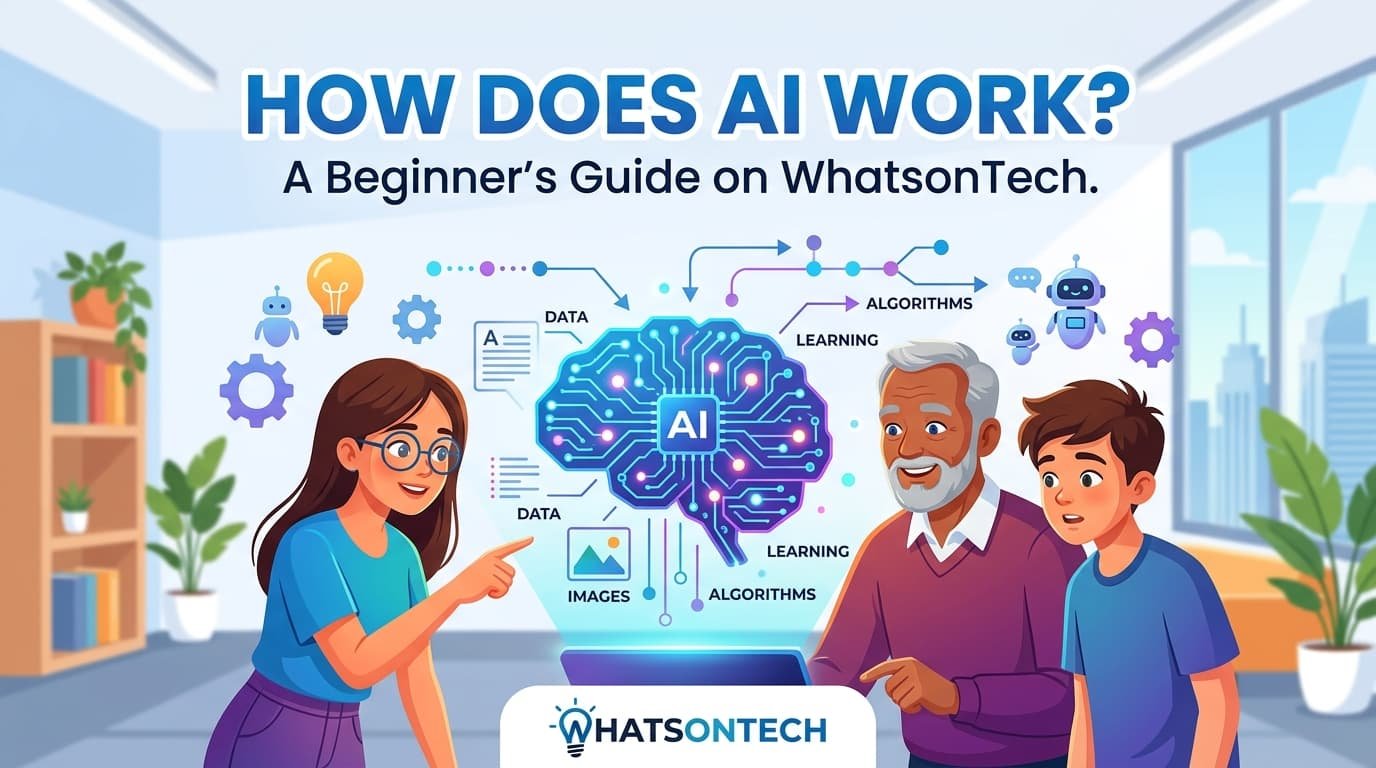
You use AI every single day, when your phone unlocks with your face, when Netflix recommends a show, and when Gmail finishes your sentence. But if someone asked you, ” How does AI work for beginners, you might struggle to explain it.
That’s exactly what this guide is for: no jargon, no math, no computer science degree required. By the end, you’ll clearly understand what AI is, how it learns, what makes it powerful, and where it’s heading in 2026 and beyond.
What Is Artificial Intelligence? A Simple Definition
Artificial intelligence is a branch of computer science that builds systems capable of performing tasks that normally require human intelligence, such as understanding language, recognizing images, making decisions, and learning from experience.
Here’s the key difference between traditional software and AI:
| Traditional Software | Artificial Intelligence |
| Follows fixed rules written by humans | Learns rules from data on its own |
| Cannot improve without manual updates | Improves automatically with more data |
| Breaks when it encounters new scenarios | Adapts to new situations |
| Gives the same output every time | Refines output over time |
Classical computer programs follow rules precisely; they do exactly what they were programmed to do. AI systems work differently: they train on data and get better over time. The more data they analyze, the better they become at predicting or recommending things.
How Does AI Work? A Step-by-Step Breakdown
Think of AI like a student. A student reads books, learns patterns, gets tested, makes mistakes, and corrects them. AI does something remarkably similar, just millions of times faster. Here is the full process:
Step 1 – Data Collection: The Fuel That Runs AI
Everything starts with data. An AI system needs examples to learn from, just like a child needs experience to understand the world.
This data can be:
- Text (books, articles, conversations)
- Images (photos, videos, medical scans)
- Numbers (sales figures, stock prices, weather readings)
- Audio (speech recordings, music)
The more relevant and high-quality the data, the smarter the AI becomes. McKinsey’s 2024 AI adoption survey found that the most successful AI implementations are those with high-quality, relevant training data, proving that AI is only as good as what it learns from.
Step 2 – Data Processing and Cleaning
Raw data is messy. Before AI can learn from it, the data must be organized, labeled, and cleaned. Irrelevant or incorrect data gets removed. This step is often the most time-consuming part of building an AI system, but skipping it leads to unreliable results.
Step 3 – Algorithms: The Instructions That Guide Learning
An algorithm is simply a set of rules or instructions. In AI, algorithms tell the system how to look for patterns in data. Different problems need different algorithms; there is no single “AI algorithm.” Some are built for image recognition, others for language, and others for prediction.
Step 4 – Machine Learning: When AI Starts Teaching Itself
Machine learning is where the real magic begins. Instead of a programmer writing every rule manually, the AI system examines data and figures out the rules on its own.
Machine Learning allows systems to learn from data. Deep Learning takes this further using advanced neural networks. Natural Language Processing helps machines understand human language. Generative AI enables systems to create content such as text, images, and code.
Step 5 – Training the AI Model
During training, the AI makes thousands, sometimes millions, of predictions. Each time it gets something wrong, it adjusts internally to do better next time. Think of it like a basketball player shooting free throws every day until the motion becomes automatic.
This iterative process continues until the AI achieves a high level of accuracy. The more data and training time, the better the model performs.
Step 6 – Testing and Validation
Once trained, the AI is tested on data it has never seen before. This reveals whether it has genuinely learned or simply memorized. Testing checks accuracy (how often does the AI make correct predictions?), bias detection (are certain outcomes unfairly favored?), and performance evaluation (how quickly and efficiently does the model operate?).
Step 7 – Deployment and Real-World Use
After passing testing, the AI goes live. It is embedded into apps, websites, devices, and services. Your voice assistant, spam filter, and recommendation engine are all trained AI models running in real time.
Step 8 – Continuous Improvement
AI does not stop learning after launch. When using an AI writing tool, the system gets better at matching your style the more you use it, because it is learning from feedback, which suggestions you accept, which you reject, and how you edit its outputs. This feedback loop is what makes modern AI systems feel increasingly personal and accurate.
What Are the Three Main Types of AI?
Not all AI is the same. Here is a simple breakdown of the three levels:
Narrow AI (What Exists Today)
Also called “Weak AI,” this is artificial intelligence designed to perform specific tasks. It is narrow because it can only do what it is trained to do, nothing more. Every AI tool available to consumers today falls into this category, incredibly good at specific jobs but unable to transfer that knowledge to other tasks.
Examples: ChatGPT, Google Translate, face recognition, spam filters.
General AI (Still Theoretical)
Artificial General Intelligence (AGI) would have the ability to understand, learn, adapt, and implement knowledge across a wide range of tasks at a human level. As of early 2026, this remains a theoretical concept, although one that is gaining more traction.
Super AI (Far Future)
Super AI refers to a system that would surpass human intelligence in nearly all tasks. This remains largely speculative and is not expected in the near term.
The Key Technologies That Power AI
Understanding AI means knowing the building blocks underneath it:
Machine Learning (ML): The core engine. AI learns from data rather than following fixed rules written by programmers.
Deep Learning: A more advanced form of machine learning. Deep learning uses neural networks, loosely inspired by how brains process information, layered on top of each other. The “deep” part refers to the many layers of transformation between input and output.
Neural Networks: The core components of neural network systems include nodes, hidden layers, and activation functions. Interconnected nodes, or artificial neurons, transmit and weigh data throughout the system. Each connection between neurons has a unique weight that amplifies or diminishes the influence of that connection.
Natural Language Processing (NLP): Allows AI to read, understand, and generate human language. Powers chatbots, translation tools, and voice assistants.
Computer Vision: Enables AI to interpret and analyze visual information, photos, videos, and scans. Used in medical imaging, self-driving cars, and security cameras.
Generative AI: The newest frontier. Rather than only classifying or predicting, generative AI creates text, images, audio, and video. Tools like ChatGPT, Midjourney, and Gemini belong here.
Real-World Examples of AI You Already Use
You interact with AI far more often than you realize. The World Economic Forum notes that over 77% of devices people use daily feature some form of AI, yet most users do not realize it.
Here are everyday examples:
- Face unlock on your phone – computer vision identifies your unique facial features
- Netflix recommendations – machine learning predicts what you will enjoy based on your history
- Gmail spam filter – NLP identifies suspicious language patterns in emails
- Google Maps traffic predictions – AI analyzes real-time location data from millions of users
- Spotify Discover Weekly – collaborative filtering matches your taste to similar listeners
- Bank fraud detection – AI flags unusual spending patterns before you even notice
Benefits of Artificial Intelligence
AI is not just a tech trend; it delivers real, measurable value:
- Speed: AI processes data in seconds that would take humans days
- Accuracy: Well-trained models make fewer errors than tired humans in repetitive tasks
- Availability: AI systems work 24/7 without breaks
- Scalability: One AI model can serve millions of users simultaneously
- Cost savings: Automation reduces overhead across industries
- Personalization: AI tailors experiences to individual users at scale
Challenges and Limitations of AI
Honest assessment matters. AI is powerful but far from perfect:
Data bias: If the training data reflects human bias, the AI will too. This has caused documented problems in hiring tools, facial recognition accuracy, and loan approval systems.
Lack of common sense: AI can beat world champions at chess but struggles with basic logical reasoning outside its training domain.
Privacy concerns: AI systems often require large amounts of personal data, raising serious questions about how that data is stored and used.
Hallucination: Large language models sometimes produce confident but completely false information. Always verify important AI outputs.
In 2026, data privacy, bias, and transparency are topmost on everyone’s mind. As AI systems are trained on human-created data, they can embody existing biases if not developed with caution. Responsible AI in the age of fairness, accountability, and trust is now a shared priority for governments, companies, and researchers.
Will AI Replace Human Jobs?
This is the question almost everyone asks, and the honest answer is: it depends on the job.
AI is already automating repetitive, rule-based tasks, data entry, basic customer support, and document sorting. Jobs that require creativity, emotional intelligence, physical dexterity in complex environments, and ethical judgment are far harder to automate.
AI has produced new types of jobs and redefined existing ones. In 2026, AI is not overwhelmingly for humans; it is about boosting people, eliminating the drudgery of repetitive tasks, and facilitating more efficient handling of complex matters.
The smarter question is not “will AI replace me?” but “how can I use AI to become more valuable?”
Is Artificial Intelligence Safe?
AI safety is a real and active area of research. Concerns include:
- Misinformation: AI can generate convincing fake content at scale
- Autonomous weapons: Military applications of AI raise serious ethical questions
- Over-reliance: Depending too heavily on AI without human oversight creates systemic risk
- Job displacement: Rapid automation without social safety nets can cause economic disruption
Globally, governments are now drafting AI regulations. The EU AI Act, US executive orders on AI, and international agreements reflect a growing consensus that oversight is necessary.
The good news: AI is safe to use as long as you stick to established tools, avoid granting broad access to personal accounts, start with a single task, review every output, and do not automate anything sensitive until you are comfortable.
How to Start Using AI as a Beginner
You do not need to know how to code. You do not need to know how a car engine works to drive a car, and you do not need to know Python to understand or use AI.
Here is a practical starting roadmap:
- Identify AI you already use – find it on your phone, browser, and streaming apps
- Try a free AI assistant – ChatGPT, Claude, or Gemini are free and beginner-friendly
- Start with one real task – draft an email, summarize an article, or generate ideas
- Learn prompt engineering – better inputs lead to better outputs
- Stay curious – follow developments, experiment, and build confidence gradually
The Future of AI: What Is Coming in 2026 and Beyond
The AI landscape in 2026 looks dramatically different from just two years ago:
- AI agents are moving beyond chat; they can now browse the web, write code, manage files, and complete multi-step tasks autonomously
- Multimodal AI understands text, images, audio, and video simultaneously
- AI in healthcare is accelerating drug discovery and assisting in diagnosis
- Edge AI runs directly on devices rather than the cloud, improving speed and privacy
- Regulation is catching up, expect more transparency requirements and usage guidelines globally
Into 2026 and beyond, AI is shifting from answering queries to becoming a cooperative tool to supercharge human potential. Those who succeed will be those who see AI not as a replacement threat or a magic solution, but as a powerful tool capable of augmenting problem-solving efforts and unlocking real value.
Frequently Asked Questions (FAQs)
What does Artificial Intelligence mean in simple terms?
AI refers to computer systems that can perform tasks normally requiring human intelligence, such as recognizing speech, making decisions, and learning from data.
Do I need to know coding to use AI?
No. Most AI tools in 2026 are designed for everyday users and require no coding knowledge whatsoever.
Is AI the same as machine learning?
No. Machine learning is a subset of AI. All machine learning is AI, but not all AI uses machine learning.
Can AI think like a human?
Not yet. Today’s AI is narrow, excellent at specific tasks but unable to reason broadly across domains the way humans do.
Is AI safe for beginners to use?
Yes, when using trusted platforms. Avoid granting broad permissions, always review AI outputs, and never share sensitive personal data with unverified tools.
Will AI replace my job?
AI automates repetitive tasks but struggles with creativity, empathy, and complex judgment. Learning to work with AI significantly increases your value in any field.
How is Generative AI different from regular AI?
Regular AI classifies or predicts. Generative AI produces new text, images, audio, and video based on patterns it has learned.
Conclusion
AI is not magic, and it is not science fiction. It is a set of tools built on data, algorithms, and pattern recognition, designed to help humans work faster, smarter, and more effectively. Understanding how it works puts you in a far stronger position, whether you are a student, a business owner, or simply a curious person who wants to stay informed.
The most important step is the first one: start using it.

Abdulrahman
Tech writer at whatsontech.net
who loves to write about Ai tools, Apps and Tech guides.