
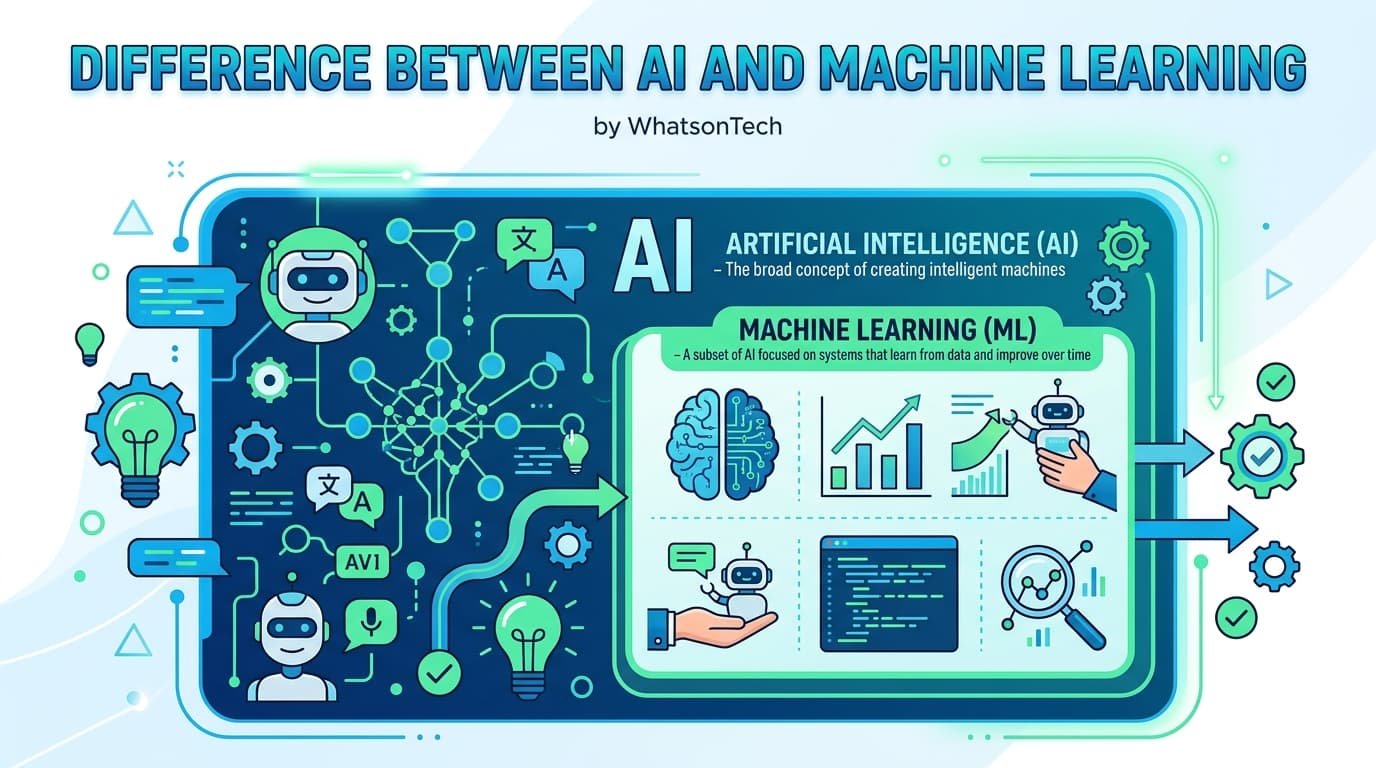
Artificial Intelligence (AI) is the broad concept of making machines simulate human intelligence. Machine Learning (ML) is a specific subset of AI that trains machines to learn from data automatically, without being explicitly programmed for every task.
If you have ever asked Siri a question, gotten a Netflix recommendation, or seen your bank flag a suspicious transaction, you have already experienced both AI and Machine Learning in action. Yet most people use these two terms interchangeably, and that is where the confusion begins.
In 2026, as these technologies power everything from autonomous vehicles to medical diagnosis, understanding the real difference between AI and Machine Learning is no longer just for engineers. It matters for business leaders, students, job seekers, and anyone trying to make sense of the tech world around them.
This guide breaks it all down, clearly, accurately, and without the jargon.
What Is Artificial Intelligence?
Artificial Intelligence, or AI, is an umbrella term for a wide range of techniques and technologies that allow machines to perform tasks that typically require human intelligence. These tasks include reasoning, problem-solving, understanding language, recognizing images, and making decisions.
Think of AI as the goal, the destination. The objective is to create computer systems that can mimic cognitive functions like a human brain.
AI systems can be built in many ways. Some use rigid, handcrafted rules. Others use statistical models trained on vast data. Still others, like today’s large language models, use deep neural networks with billions of parameters. They all fall under the AI umbrella.
Examples of AI in Real Life (2026)
- Voice assistants: Alexa, Siri, Google Assistant
- Self-driving car systems (Tesla Autopilot, Waymo)
- AI-generated content tools like ChatGPT and Claude
- Robotic process automation in manufacturing
- AI-powered medical diagnostic tools in hospitals
- Smart email filters and spam detection
What Is Machine Learning?
Machine Learning is a specific branch of AI. Rather than following hardcoded rules, ML systems learn patterns from large amounts of historical data and use those patterns to make predictions or decisions on new, unseen data.
In simple terms, instead of telling a computer every step to take, you feed it examples and let it figure out the rules on its own.
The Three Core Types of Machine Learning
- Supervised Learning – The model trains on labeled data. Example: teaching a spam filter using thousands of labeled “spam” and “not spam” emails.
- Unsupervised Learning – The model finds hidden patterns in unlabeled data. Example: customer segmentation in marketing.
- Reinforcement Learning – The model learns through reward and punishment signals. Example: training a game-playing AI like AlphaGo.
Examples of Machine Learning in Real Life (2026)
- Netflix and YouTube recommendation engines
- Fraud detection systems at banks using decision trees and random forests
- House price prediction models in real estate
- Predictive analytics in supply chain management
- Email spam filtering
AI vs Machine Learning: Key Differences Explained
The most important thing to understand is this: all Machine Learning is AI, but not all AI is Machine Learning.
Machine Learning is just one approach within the broader AI field. AI also includes rule-based systems, expert systems, natural language processing, computer vision, and robotics, all of which do not necessarily involve ML.
| Factor | Artificial Intelligence (AI) | Machine Learning (ML) |
| Definition | A broad concept of simulating human intelligence in machines | A subset of AI that learns from data without explicit programming |
| Scope | Very broad — includes ML, robotics, NLP, expert systems | Narrower — focused on pattern recognition and predictions |
| Goal | Build intelligent systems that mimic human cognition | Build models that improve automatically from data |
| Data Requirement | May or may not require large data (rule-based AI does not) | Always requires large volumes of training data |
| Learning Ability | Traditional AI does not learn; it follows rules | Learns and improves over time with more data |
| Examples | Siri, expert systems, robotics, chatbots | Netflix recommendations, fraud detection, spam filters |
| Tools Used | Prolog, knowledge graphs, planning algorithms | Python, Scikit-learn, TensorFlow, PyTorch |
| Human Intervention | High in rule-based AI; low in advanced AI | Minimal — model trains and improves on its own |
The Relationship Between AI, ML, and Deep Learning
To visualize this properly, think of three nested circles:
🔵 Artificial Intelligence (outermost) → contains everything
🟢 Machine Learning → a subset inside AI
🟠 Deep Learning → a subset inside ML, using neural networks
Deep Learning is a type of Machine Learning that uses artificial neural networks with many layers (hence “deep”) to process unstructured data like images, audio, and text. It powers the most impressive AI applications today, including large language models like ChatGPT and image generators like DALL-E.
A Quick Comparison
| Technology | Subset of | Typical Use Case |
| AI | Parent field | Autonomous robots, expert systems |
| Machine Learning | AI | Recommendations, fraud detection |
| Deep Learning | Machine Learning | Image recognition, voice assistants, LLMs |
| NLP | AI (often uses ML/DL) | Chatbots, translation, sentiment analysis |
How AI and Machine Learning Work Together in 2026
In today’s real-world applications, AI and ML rarely work in isolation. Most advanced AI systems use Machine Learning as their core engine. A customer support chatbot, for example, is an AI product, but under the hood, it uses NLP models trained via Machine Learning to understand what the user is asking.
Consider how a bank’s fraud detection system operates. The overall system is an AI application designed to protect customer accounts. The actual pattern recognition, identifying unusual transaction behavior, is handled by ML algorithms trained on millions of past transactions.
As of 2026, generative AI has become the dominant conversation in tech. Models like GPT-4o, Gemini Ultra, and Claude 3.5 are all built on Deep Learning, which is itself built on Machine Learning principles. So when you see “AI-powered” in a product description today, it almost certainly means Machine Learning is doing the heavy lifting underneath.
When to Use AI vs When to Use Machine Learning
Choosing between an AI approach and a Machine Learning approach depends on your problem type, data availability, and performance requirements.
- Use rule-based AI when your problem has clearly defined logic, limited data, and predictable outcomes. Example: a tax calculation system.
- Use Machine Learning when patterns are too complex for manual rules, data is plentiful, and the system needs to improve over time. Example: a recommendation engine.
- Use Deep Learning (a type of ML) when your data is unstructured, like images, audio, or raw text, and you need state-of-the-art accuracy. Example: a medical imaging diagnostic tool.
AI vs Machine Learning: Career Perspective in 2026
Both fields continue to offer strong job growth in 2026. AI engineers tend to have broader responsibilities, including system design, integration, and deployment, and earn slightly higher average salaries. Machine Learning engineers focus more deeply on algorithm development, data modeling, and model optimization.
| Role | Average Salary (2026) | Core Skills |
| AI Engineer | ~$164,000/year (US) | System architecture, NLP, integration, deployment |
| ML Engineer | ~$156,000/year (US) | Python, statistical modeling, data pipelines, model evaluation |
| Data Scientist | ~$130,000/year (US) | Data analysis, visualization, ML basics, SQL |
If you are just starting, the recommended learning path for 2026 is: Data Science fundamentals → Machine Learning → AI specialization (NLP, computer vision, or generative AI).
Common Misconceptions About AI and ML
- Misconception: AI and Machine Learning are the same thing.
Reality: ML is just one tool within the much larger AI toolbox. - Misconception: All AI learns on its own.
Reality: Traditional, rule-based AI systems do not learn at all. - Misconception: More data always means better AI.
Reality: Data quality matters more than quantity, especially in ML. - Misconception: AI will replace all human jobs.
Reality: AI and ML are tools that augment human decision-making; they shift job roles rather than eliminate them.
Conclusion
The difference between AI and Machine Learning is not complicated once you see the relationship clearly. AI is the big picture, the goal of intelligent machines. Machine Learning is one of the most powerful methods to get there.
In 2026, these two fields have never been more intertwined. Whether you are exploring a tech career, building a product, or simply trying to understand the technology shaping your world, knowing how AI and ML differ, and how they work together, gives you a genuine edge. Start with the fundamentals, stay curious, and the rest will follow.

Abdulrahman
Tech writer at whatsontech.net
who loves to write about Ai tools, Apps and Tech guides.