
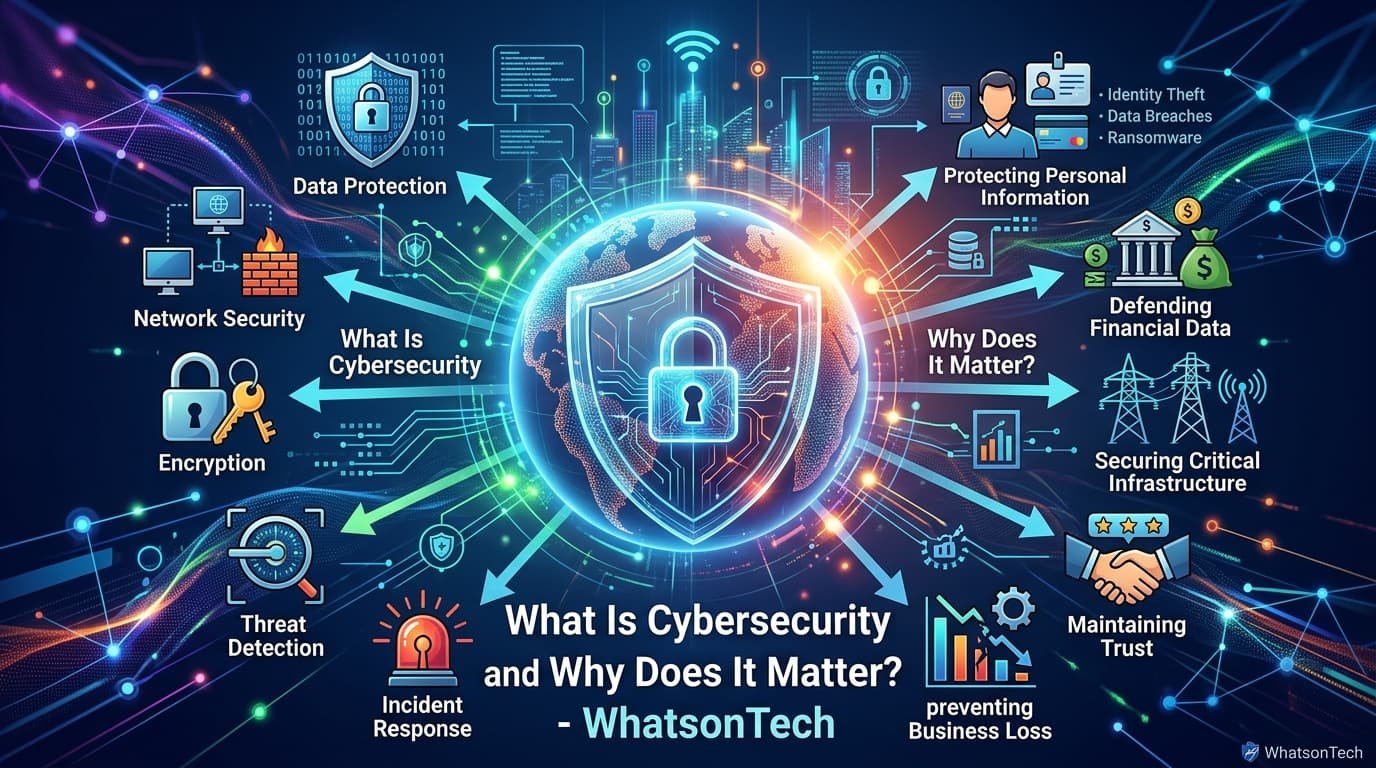
Every 2 seconds, a business or individual somewhere in the world falls victim to a cyberattack. That’s not a prediction, that’s the reality of 2026. As our lives move deeper into the digital world, the question is no longer if you’ll be targeted, but when. Understanding Cybersecurity isn’t just for IT professionals anymore. It’s something everyone, business owners, and organizations need to take seriously.
This guide breaks down exactly what cybersecurity is, why it matters more than ever, and how you can stay protected.
What Is Cybersecurity?
Cybersecurity is the practice of protecting computers, networks, systems, and data from unauthorized access, theft, damage, or disruption. It combines technology, people, and processes to defend digital assets against a wide range of threats, from simple phishing emails to sophisticated nation-state attacks.
At its core, cybersecurity is built around three guiding principles, often called the CIA Triad:
| Principle | What It Means |
| Confidentiality | Ensuring only authorized people can access sensitive information |
| Integrity | Keeping data accurate and unaltered by unauthorized parties |
| Availability | Making sure systems and data are accessible when needed |
These three pillars form the foundation of every cybersecurity strategy, whether you’re protecting a personal laptop or a Fortune 500 company’s cloud infrastructure.
Why Does Cybersecurity Matter in 2026?
The short answer: because almost everything we do is now digital.
Online banking, healthcare records, government databases, school systems, and business operations all run on interconnected networks. When those networks are compromised, the consequences are real and expensive.
Here’s how serious the situation is right now:
- Global cybercrime costs are projected to reach $10.5 trillion in 2026, up 15% year-over-year
- The average cost of a data breach globally sits at $4.88 million
- 95% of all cybersecurity breaches involve human error in some form
- Phishing attacks account for 42% of all global breaches
- 68% of breaches involve human error, social engineering, or credential misuse (Verizon DBIR 2025)
These aren’t just corporate problems. When companies lose your data, it’s your identity, your money, and your privacy at risk.
The Real-World Impact on Individuals
For everyday people, a cyberattack can mean:
- Bank accounts drained through credential theft
- Personal photos or files locked by ransomware
- Identity stolen and used to take out loans or commit fraud
- Social media accounts hijacked for scams
The Real-World Impact on Businesses
For organizations, the damage goes further:
- Regulatory fines under laws like GDPR and HIPAA
- Loss of customer trust and brand reputation
- Operational downtime costs thousands per hour
- Legal liability if customer data is exposed
The Main Types of Cybersecurity
Cybersecurity isn’t one-size-fits-all. It’s broken into several domains, each addressing a different part of the digital environment.
1. Network Security
Protects the infrastructure that connects devices — routers, switches, firewalls, and wireless systems. Tools include intrusion detection systems (IDS), VPNs, and next-generation firewalls.
2. Cloud Security
As businesses move to AWS, Azure, and Google Cloud, protecting cloud environments has become critical. Cloud security covers access control, data encryption, and configuration management.
3. Application Security
Focuses on securing software from vulnerabilities during development. The OWASP Top 10 is the gold standard for understanding the most common web application risks.
4. Endpoint Security
Covers every device that connects to a network, including laptops, smartphones, tablets, and IoT devices. With remote work now standard, endpoint security has become one of the most important defense layers.
5. Identity and Access Management (IAM)
Controls who can access what. Multi-factor authentication (MFA), zero trust architecture, and role-based access control all fall under this category. Notably, modern MFA is assessed to prevent over 99% of identity-based attacks.
6. Operational Security (OpSec)
The processes and decisions around handling and protecting data. It includes policies on who can access data, where it’s stored, and how it’s shared.
Most Common Cyber Threats You Need to Know
Understanding the threat landscape is the first step toward protecting yourself or your organization.
Phishing
The most common attack method. Cybercriminals send fake emails or messages pretending to be trusted sources, tricking victims into clicking malicious links or entering credentials. Since generative AI went mainstream in late 2022, McKinsey reports phishing attacks have increased by 1,200%.
Ransomware
Malware that encrypts your files and demands payment to restore access. In Q2 2025, the average ransomware payout doubled in just one quarter. Annual global damage from ransomware is forecast to hit $74 billion in 2026.
Malware
A broad category including viruses, worms, trojans, and spyware, any software designed to harm or exploit a system.
Social Engineering
Attacks that exploit human psychology rather than technical vulnerabilities. An attacker might impersonate an IT helpdesk worker to get an employee to hand over their password.
Zero-Day Exploits
Attacks that target software vulnerabilities before the vendor has issued a fix. In 2023, 11 of the top 15 most exploited vulnerabilities were initially exploited as zero-days.
Insider Threats
Threats that come from within an organization, employees, contractors, or partners who misuse access, intentionally or accidentally. The average annual cost of insider incidents now exceeds $17 billion for many companies.
How Cybersecurity Works: Key Tools and Strategies
Modern cybersecurity is layered. No single tool stops all attacks, which is why defense-in-depth, multiple overlapping layers of protection, is the standard approach.
Core tools and technologies include:
- Firewalls – monitor and filter incoming and outgoing network traffic
- Antivirus/EDR software – detect and remove malware from endpoints
- SIEM systems – collect and analyze security event data in real time
- Encryption – scrambles data so it’s unreadable without the correct key
- Multi-Factor Authentication (MFA) – requires more than just a password to log in
- Penetration testing – simulated attacks to find weaknesses before real attackers do
The Zero Trust Model
One of the most important frameworks in cybersecurity right now is Zero Trust: the principle that no user, device, or system should be trusted by default, even if they’re already inside the network.
Every access request is verified. Every device is checked. Least-privilege access means users only get what they need, nothing more.
The zero trust security market is valued at $48.43 billion in 2026 and is expected to more than double by 2031, which tells you everything about where the industry is heading.
Cybersecurity by Industry: Who’s Most at Risk?
Some sectors face far greater exposure than others due to the sensitivity of their data.
| Industry | Average Breach Cost (2026) |
| Healthcare | $12.6 million per incident |
| Financial Services | $6.4 million per incident |
| Manufacturing | Fastest rising costs (up 18% YoY) |
| Global Average | $4.88 million per incident |
Healthcare consistently tops the list because patient records contain everything a criminal needs for identity theft, insurance fraud, and extortion.
Cybersecurity Best Practices for Individuals and Small Businesses
You don’t need a dedicated security team to reduce your risk significantly. These practices make a measurable difference:
For individuals:
- Use strong, unique passwords for every account (use a password manager)
- Enable MFA on every platform that offers it
- Keep your software, apps, and operating system updated
- Be skeptical of unexpected emails, links, and attachments
- Back up important files regularly, offline or to a secure cloud
For small businesses:
- Train employees on phishing recognition, as human error causes 95% of breaches
- Limit access to sensitive data using role-based permissions
- Use a reputable endpoint security solution across all devices
- Have an incident response plan, and know what to do before something happens
- Consider partnering with a Managed Security Service Provider (MSSP); in 2025, organizations using MSSPs reported lower average breach costs.
The Future of Cybersecurity: AI, Quantum, and What’s Coming
The cybersecurity landscape is changing fast, and two forces are reshaping it more than anything else.
AI as a weapon: Cybercriminals are using AI to generate more convincing phishing emails, automate attacks, and bypass traditional defenses faster than ever.
AI as a shield: Security teams are deploying AI to detect anomalies, automate threat response, and manage the overwhelming volume of security alerts. Organizations using AI-powered security tools reduce breach costs by an average of $2.2 million annually.
Quantum computing poses a longer-term threat. “Harvest now, decrypt later” attacks, where encrypted data is stolen today to be decrypted once quantum computers mature, are pushing organizations toward post-quantum cryptography now.
Global information security spending is projected to reach $183.9 billion in 2026, a 15% jump year-over-year. The AI cybersecurity market alone is expected to exceed $133 billion by 2030.
Cybersecurity Careers: A Field With More Demand Than Supply
If you’re considering a tech career, cybersecurity offers some of the strongest job security in the industry.
Between May 2024 and April 2025, there were over 514,000 cybersecurity job openings in the United States alone, with demand far exceeding the available workforce.
Popular roles include:
- Security Analyst
- Penetration Tester (Ethical Hacker)
- Cloud Security Engineer
- Chief Information Security Officer (CISO)
- Incident Response Specialist
Top certifications to pursue:
- CompTIA Security+
- Certified Ethical Hacker (CEH)
- CISSP (Certified Information Systems Security Professional)
- CISM (Certified Information Security Manager)
Frequently Asked Questions (FAQs)
What is cybersecurity in simple terms?
Cybersecurity is the practice of protecting your digital devices, networks, and data from hackers, thieves, and unauthorized access.
Why is cybersecurity important for small businesses?
Small businesses are frequently targeted because they often have weaker defenses; a single breach can cost millions and permanently damage customer trust.
What are the most common types of cyberattacks?
Phishing, ransomware, malware, social engineering, and credential theft are the most frequently reported attack types globally.
What is the CIA Triad in cybersecurity?
It stands for Confidentiality, Integrity, and Availability, the three core principles every security strategy is built around.
How much does a data breach cost on average?
The global average cost of a data breach is $4.88 million in 2026, with U.S. breaches averaging significantly higher at over $10 million.
What is Zero Trust security?
Zero Trust is a security model where no user or device is automatically trusted; every access request is verified regardless of where it originates.
Can AI help with cybersecurity?
Yes. AI-powered security tools help detect threats faster and automate responses, reducing breach costs by an average of $2.2 million annually for organizations that use them.
How do I start a career in cybersecurity?
Begin with foundational certifications like CompTIA Security+, build hands-on skills through labs and CTF challenges, and target entry-level analyst or SOC roles.
Conclusion
Cybersecurity is no longer a background concern reserved for IT departments and government agencies. It’s a front-line issue that affects every person who uses a smartphone, every business that stores customer data, and every government that runs critical infrastructure.
The threats are growing faster, getting smarter, and costing more than ever. But so are the tools, strategies, and professionals fighting back.
Whether you’re an individual looking to protect your accounts, a business owner trying to stay compliant, or someone exploring a new career path, understanding cybersecurity is the first step. The second step is acting on that knowledge.
Start with the basics: strong passwords, MFA, regular updates, and awareness. Then build from there. In a world where cybercrime costs $10.5 trillion a year, the cost of doing nothing is simply too high.

Abdulrahman
Tech writer at whatsontech.net
who loves to write about Ai tools, Apps and Tech guides.